Grow Your Company.
Not Your Headcount.

A hands-on program for operators building human + agent organizations — sprint-based, coach-led, with AI diagnostic tools built into the work.

A sprint methodology that works

Six steps from diagnosis to deployment — one sprint at a time, each one building on the last.

Bi-weekly coaching sessions

Work directly with Compound throughout each sprint to design, build, and measure what changes.

AI diagnostic tools built in

Access to purpose-built agents that help your team identify constraints and design solutions — tools we build with you, not for you.

Workshop session

Your team has access to ChatGPT. Some of them use it. You’re not sure what, if anything, changed.

Maybe you bought Copilot. Maybe you hired an AI champion and gave them a budget. Maybe your ops lead came back from a workshop with a deck full of use cases that nobody implemented. You did the responsible thing.

None of it touched the structure of how work actually gets done. And that’s not a people problem or a technology problem — it’s a design problem nobody has handed you a map for yet.

THE WORK

How a Compound Sprint works

01Signal

Find the one problem worth solving first

Before anything gets built, you and your Compound team identify the one operational problem where an agent can take over — and where the return is clear enough that the sprint pays for itself.

02Source

Map everything the work actually requires

You can't automate what you don't understand. This step maps the knowledge, context, and judgment the work actually requires — the foundation the agent gets built on.

03Design

Decide who does what, and make it official

The concrete output here is the Hybrid Accountability Chart — a working document that defines which tasks stay with your people, which move to agents, and who owns every handoff.

04Build

Deploy it into the workflow that already exists

The agent gets built into the workflow your team already uses — not a separate system that looks good in a demo and gets ignored by week three.

05Deliver

Run the sprint and measure what actually changed

At sprint close, you have a clear read on what the agent is handling well, where it still needs a person, and what that difference translates to in time and cost.

06Compound

Run the next sprint on the infrastructure you just built

Everything from Sprint One — the chart, the agent, the redesigned workflow — carries forward as the foundation for Sprint Two. Each sprint compounds the last.

IS THIS FOR YOU

The Sprint Partner Program is built for one kind of operator.

Is Compound right for you? →
You're running between $5M and $100M in revenue, and adding headcount to solve growth problems is getting more expensive than it used to.
You've already put money into AI tools, and when you look at your operations honestly, you can't point to what changed.
You're already running a structured operating model — EOS, Scaling Up, or similar — and you want to add an AI layer deliberately, not experimentally.
You're the kind of operator who moves when something makes sense, without waiting six months for everyone in the room to agree.
You want to be the one in your peer group who got ahead of this while there was still an advantage in being early — not the one explaining, two years from now, why you waited.

FROM THE WORK

What we’re learning — sprint by sprint.

Short field notes from inside active sprints. Each one is under three minutes. No theory — just what we found when we actually built it.

See all field notes →

WORK ARCHITECTURE

Fifty-six percent of CEOs say AI hasn't produced results. Here's what the data actually shows.

IBM, Fortune, and MIT studied this independently and reached the same conclusion: the variable isn't the technology.

0:44

ORCHESTRATED ORGANIZATION

There's a term for what the best AI-era companies are building. McKinsey calls it one thing. We call it something else.

Why 'agentic organization' and 'superagency' miss the design discipline underneath — and what the right framing actually demands of an operator.

0:40

WORK ARCHITECTURE

If your AI investments haven't worked, you're probably blaming the wrong thing.

McKinsey found the number-one company response to AI was education. That's the right answer to a technology problem — and this isn't a technology problem.

0:42

OPERATING SYSTEM EVOLUTION

If you run on EOS, you already have an AI sprint backlog. You just call it something else.

The Issues List maps directly onto the Signal component — same discipline, different vocabulary. The framework already exists.

0:37

WORK ARCHITECTURE

There's a difference between a symptom and a constraint. Most AI projects address the wrong one.

Automate a symptom and you've made the wrong process faster. Solve a constraint and an entire category of problems disappears.

0:38

OPERATING SYSTEM EVOLUTION

EOS published the Accountability Chart in 2007. It's still useful. It just needs a new column.

AI agents are handling real work in EOS companies — intake, analysis, routing decisions. The chart doesn't have a field for any of it.

0:59

WHO BUILT THIS

We ran this on ourselves first.

We ran this on ourselves first. Applying these systems to our own operations cut our headcount by 50% while we doubled profits — without replacing anyone. That's what we're building with Sprint Partners.

Read the full story →

Jesse Flores

Built the first agent team inside his own operations.

Julie Mann

20+ years designing how organizations actually operate.

FREE

Read the methodology before you book a call.

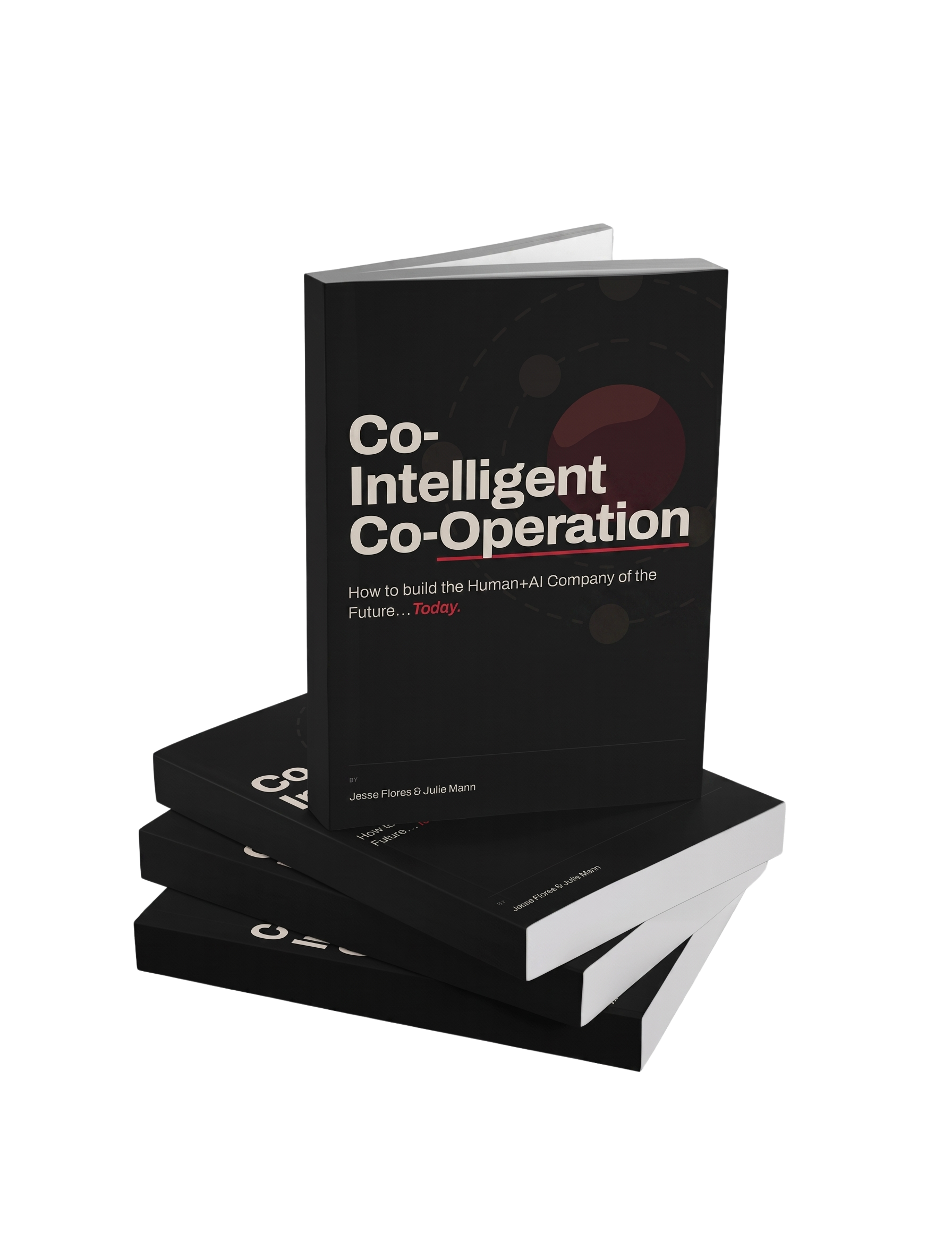
The Compound GrowthMap is a free guide to redesigning your organization for AI — before you select another tool, hire another person, or run another pilot that goes nowhere.

We don't send spam. Unsubscribe anytime.

THE SPRINT PARTNER PROGRAM

Your implementation roadmap is free.

Answer a few questions about your operations and get a personalized, step-by-step implementation plan — what to build first, where agents fit, and what your org should actually look like when it's done right. Sprint Partners get bi-weekly coaching, quarterly sprints, and access to AI diagnostic tools we build together.

We're limiting the inaugural cohort to five Sprint Partners so we can run each sprint with the attention it requires. Those spots are filling now.